SmokeHazard.com
Identify. Understand. Protect.
Understand what wildfire and structure-fire smoke can contain, how it affects indoor air, why residue can persist, and when filtration, cleaning, or professional evaluation may be needed.
Per CDC guidance, these groups warrant the lowest threshold for getting a smoke-impacted home evaluated.
Lingering residue exposure is chronic and low-grade — symptoms are easy to blame on allergies, a cold, or "just a smell." The pattern to watch: symptoms that started after the fire event and ease when you leave the house for a few days.
Your nose adapts to persistent smells within days — and many fire VOCs are harmful at concentrations below what you can smell at all. "It doesn't smell smoky anymore" is not evidence the exposure ended. Laboratory testing is.
During a smoke event, porous materials — carpet, insulation, mattresses, drapes, books — absorb smoke gases at a rapid rate. Afterward, the process reverses slowly: those materials off-gas volatile organic compounds back into indoor air for months to years, while settled soot and ash re-suspend whenever they're disturbed.
This is why airing the house out helps for a day and then the smell — and the exposure — returns. The reservoir is inside the materials, not in the air.
For the building-science deep dive, see SmokeDamage.org: Smoke damage without a fire.
NIST research on a smoke-contaminated house found that many smoke VOCs persisted indoors for days after the smoke was introduced — with building surfaces acting as reservoirs that keep re-emitting compounds into the air.
Critically, the study found that surface cleaning reduced indoor smoke VOCs more effectively and more persistently than portable air cleaners or opening windows. Filtration helps with airborne particles; it does not empty the reservoir in your walls, floors, and furnishings.
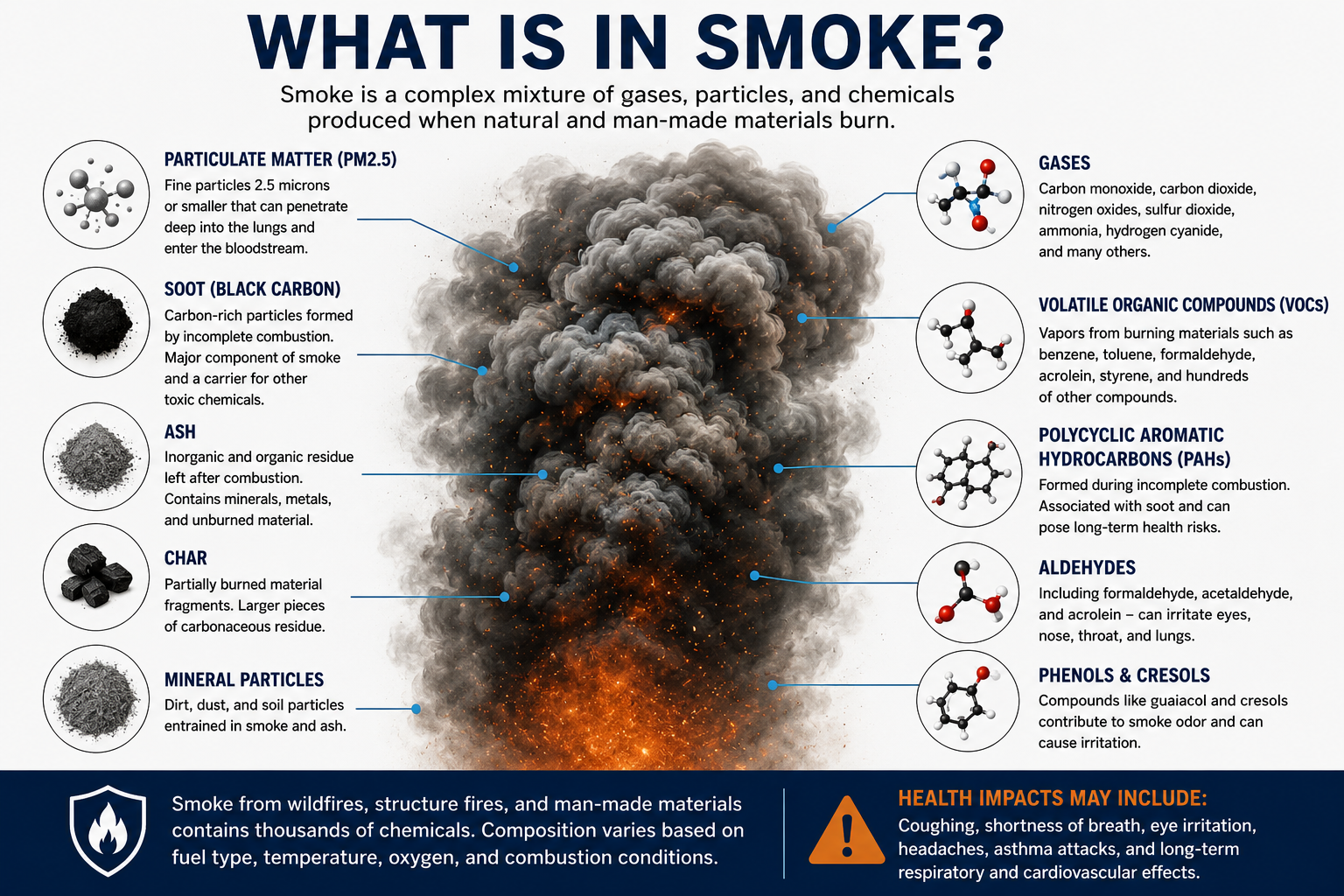
Smoke from wildfires, structure fires, and man-made materials contains thousands of chemicals — and the composition changes with fuel type, temperature, oxygen, and combustion conditions. Many of these compounds can be measured indoors long after the event using laboratory VOC air-sampling methods.
Smoke inhalation is the leading cause of death in home fires. Fire-safety research shows home-fire smoke is thick, black, toxic, and fast — filling a one-story home within minutes, from the ceiling down. The same properties that make it deadly during a fire are what drive it deep into nearby buildings and materials afterward.
Certified specialists test surfaces, ducting, and insulation for combustion particles and fire VOCs — free, with laboratory documentation. If contamination is found, remediation is typically covered by homeowner insurance.